
When your pay changes, plan from your lowest normal pay, not your best. Pay your needs first, keep a buffer for the lean weeks and, if you can, pay yourself the same amount each week from a holding account. If you work on an ABN, set aside money for tax as you go.
1Find your baseline
Look back over the last three to six months of pay, or twelve if your work is seasonal. Find the lowest week or month that was still fairly normal. Ignore a one-off like a week you were sick. That number is your baseline, and it is what you budget your needs on.
Planning from a good week is the most common trap. The good weeks feel normal and the slow weeks feel like a crisis.
2Put your spending in order
When money comes in, pay things in this order:
- Needs: rent, groceries, bills and transport
- Minimum repayments on any debts
- Your buffer and savings
- Wants
Anything you earn above your baseline is a bonus. Split it on purpose: some to your buffer, some to savings and some to enjoy.
3Pay yourself a steady wage
Have all your income land in one account, then move the same amount into your everyday account each week, like a regular wage. Good weeks top up the holding account. Slow weeks draw on it.
This works best once the holding account has a buffer of about a month of needs. Build that first, and the ups and downs start to disappear from your day-to-day spending.
4Know how your tax and super work
- Casual employees usually have tax taken out of each pay, and your employer pays super on top.
- ABN contractors and sole traders usually have no tax taken out, so the full payment is not all yours to spend. Move a share of every payment into a separate tax account as soon as it arrives. You may also need to arrange your own super.
The ATO website or a registered tax agent can help you work out how much to set aside.
5Plan for the lean weeks now
Decide ahead of time what you would cut first if a slow week hits: takeaway, a subscription, a night out. Making that call on a calm day is much easier than in the middle of a tight week.
A weekly budget suits irregular pay better than a monthly one, because you can see quickly when a week is running short.
A budget that moves at your pace
Set a weekly budget in Cleer and see what you have spent on needs and wants so far this week, and where you are heading before the week ends.
Download free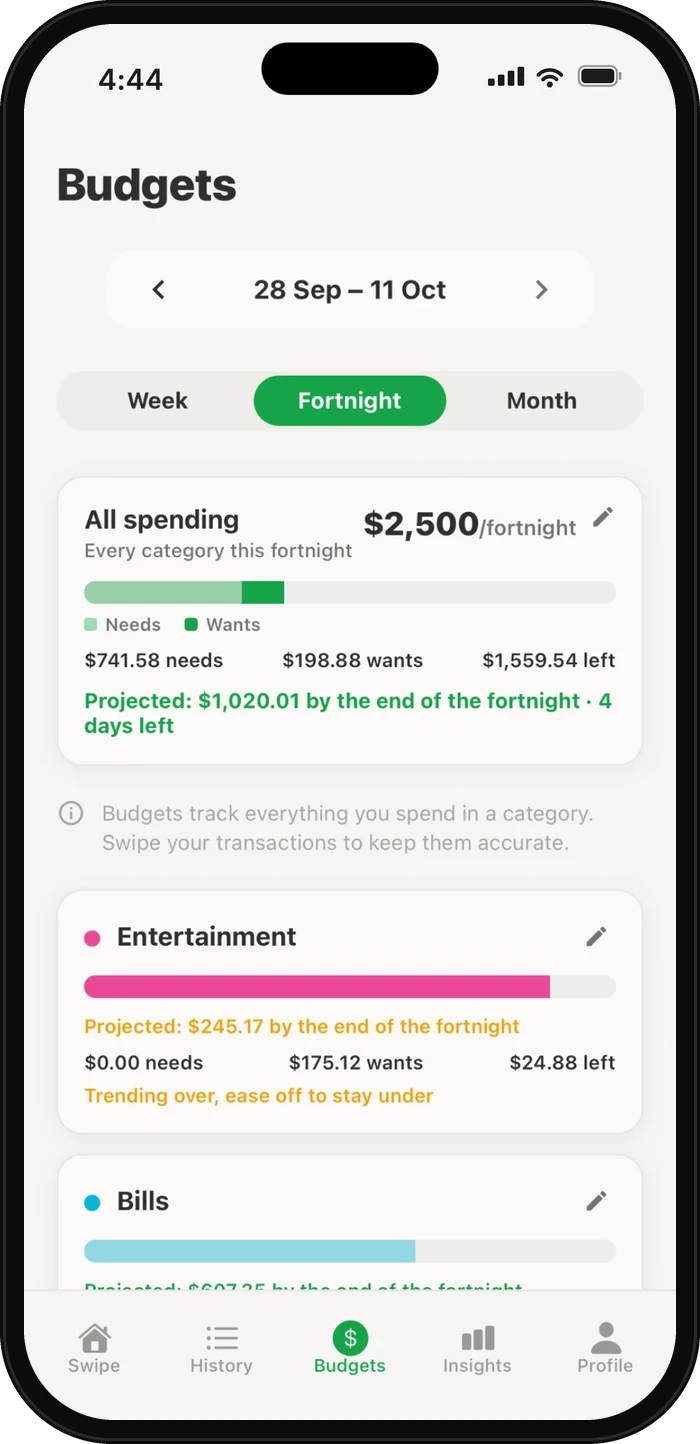
Irregular income in five points
- Budget your needs on your lowest normal pay.
- Pay needs first, then repayments, savings and wants.
- Pay yourself a steady amount from a holding account.
- On an ABN, set aside tax from every payment.
- Decide what to cut in a lean week before it happens.
Keep reading
General information only. This guide does not take your personal situation into account and is not financial advice. For free, independent help, visit Moneysmart or call the National Debt Helpline on 1800 007 007.