
A budget is just a plan for your pay. Write down what you take home, take out the needs you cannot skip, set aside some savings and the rest is yours for wants. Then check in once a week. That is the whole thing.
What you need before you start
- Your last payslip, or the amount that lands in your account each pay
- Your bank app open on last month's transactions
- A notes app or a piece of paper
1Know what you take home
Start with the money that actually reaches your account, after tax and super. That is the number you get to plan with, not your salary.
Pick one period and stick with it. If you are paid fortnightly, plan per fortnight. Mixing weekly, fortnightly and monthly numbers is the most common reason a first budget does not add up.
2List your needs
Needs are the costs you could not reasonably skip this period. For most people that looks like:
Scroll back through last month to get real numbers rather than guesses. If a bill is monthly but you plan fortnightly, multiply it by 12 and divide by 26. A $130 monthly phone and internet bill works out to $60 a fortnight.
Not sure if something is a need? Ask "would I be worse off in a real way if I stopped this tomorrow?" If the honest answer is no, it is a want. Our needs vs wants guide covers the grey areas.
3Pay yourself first
Before you plan any fun money, decide what goes to savings. Even a small, regular amount builds the habit. Set up an automatic transfer for payday so you never have to remember it.
4What is left is for wants
Take your pay, subtract needs and savings and the rest is your wants budget: eating out, streaming, clothes, weekends away. This is not a punishment number. It is permission to spend it without guilt.
Here is how that looks for an example person paid $2,400 a fortnight:
| Item | Type | Per fortnight |
|---|---|---|
| Take-home pay | $2,400 | |
| Rent | Need | $900 |
| Groceries | Need | $260 |
| Power and gas | Need | $90 |
| Transport | Need | $80 |
| Insurance | Need | $70 |
| Phone and internet | Need | $60 |
| Savings transfer | Savings | $380 |
| Left for wants | Wants | $560 |
Example figures only, to show the maths. Your numbers will be different.
5Check in once a week
Pick a regular time, like Sunday night. Look at what you spent and ask one question: am I on track for wants this period? If you are over, ease off for a few days. If you are under, nice work.
Your first budget will be a little wrong, and that is fine. After two or three check-ins you will know which numbers to nudge.
Let Cleer do steps 2 and 5 for you
Cleer connects to your bank, imports your spending and lets you sort each purchase as a want or a need with a swipe. Set a budget for the week, fortnight or month and see where you stand any time.
Download free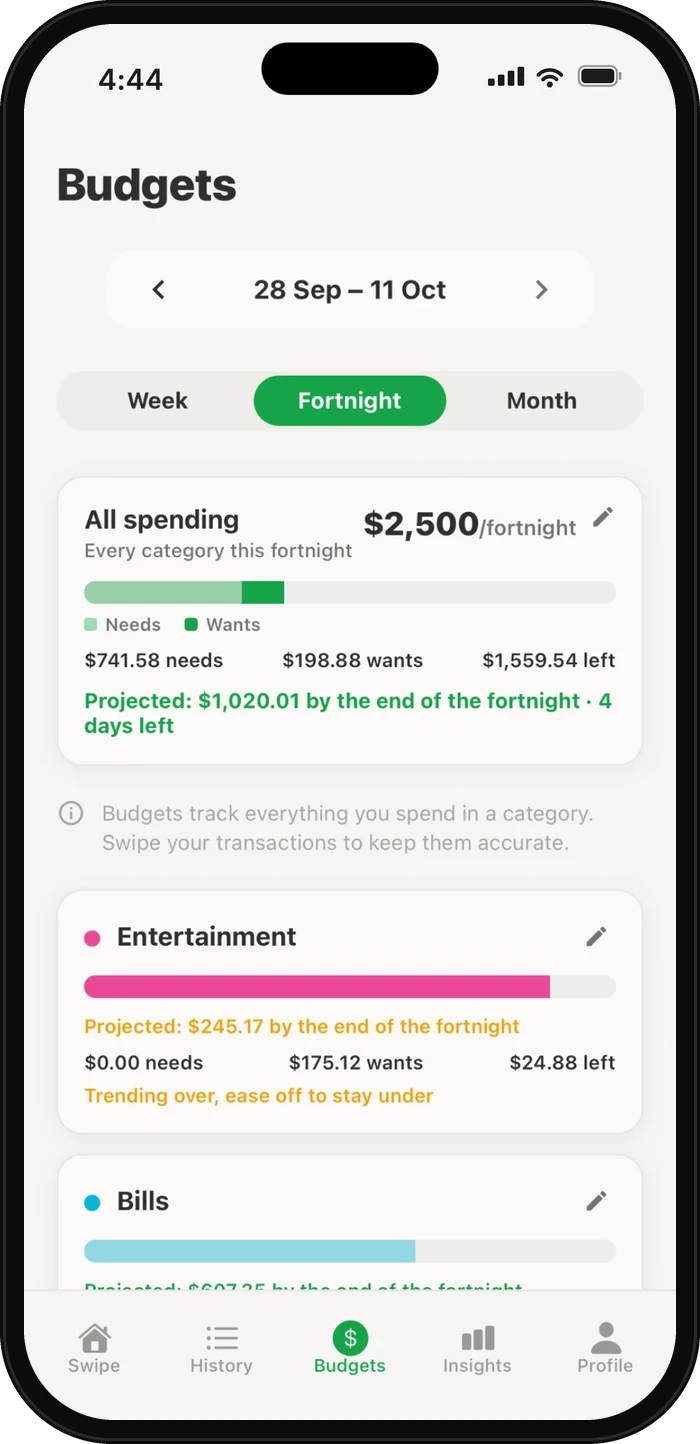
Your first budget in five points
- Plan with your take-home pay, in one period.
- Use last month's real numbers for your needs.
- Move savings out on payday, before you spend.
- What is left is your guilt-free wants money.
- Check in weekly and adjust. It gets easier.
Keep reading
General information only. This guide does not take your personal situation into account and is not financial advice. For free, independent help, visit Moneysmart or call the National Debt Helpline on 1800 007 007.