
Plan everything per fortnight. Convert monthly bills by multiplying by 12 and dividing by 26, move that bill money into a separate account each payday and pay your bills from there. Because there are 26 pays in a year, two months will have three paydays.
Why fortnightly pay feels tricky
Your pay arrives every 14 days, but bills run on their own clocks: rent might be monthly, power quarterly and car rego yearly. Some pays end up carrying rent, power and insurance all at once, while the next carries almost nothing. The fix is to make every pay look the same.
1Turn every bill into a fortnightly amount
Use these conversions so every cost is in the same unit as your pay:
| Bill comes | To get per fortnight | Example |
|---|---|---|
| Weekly | Multiply by 2 | $45 a week is $90 |
| Monthly | Multiply by 12, divide by 26 | $1,950 a month is $900 |
| Quarterly | Multiply by 4, divide by 26 | $390 a quarter is $60 |
| Yearly | Divide by 26 | $1,300 a year is $50 |
Example figures only.
A common mistake is halving a monthly bill. Two fortnights are 28 days but a month averages about 30, so halving sets aside more than the bill needs: $975 a fortnight instead of $900 on $1,950 rent. That makes your budget look tighter than it really is.
2Give your bills their own account
Open a second everyday account just for bills. Each payday, move your fortnightly bill total into it, ideally with an automatic transfer. When a bill lands, it comes out of that account, and the money is already sitting there.
This turns lumpy bills into one steady amount every pay. What stays in your main account is yours to plan for groceries, wants and savings.
3Line up your due dates
Many providers will let you change your due date or pay in smaller amounts more often. Moving big bills to just after payday, or paying rent fortnightly if your agent allows it, means less juggling.
4Plan for the three-pay months
Twelve months of two pays is only 24 pays, but a fortnightly pay comes 26 times a year. So in two months of the year you get a third payday.
If you plan per fortnight with the conversions above, those pays are already counted. If you plan per month assuming two pays, those two extra pays are money your budget did not expect. Decide now where they go: savings, a yearly bill or paying down debt.
A budget that runs on your pay cycle
Cleer lets you set budgets per week, fortnight or month, and you can line the fortnight up with your payday in Settings. On Pro, bill reminders give you a heads-up the day before regular bills are due.
Download free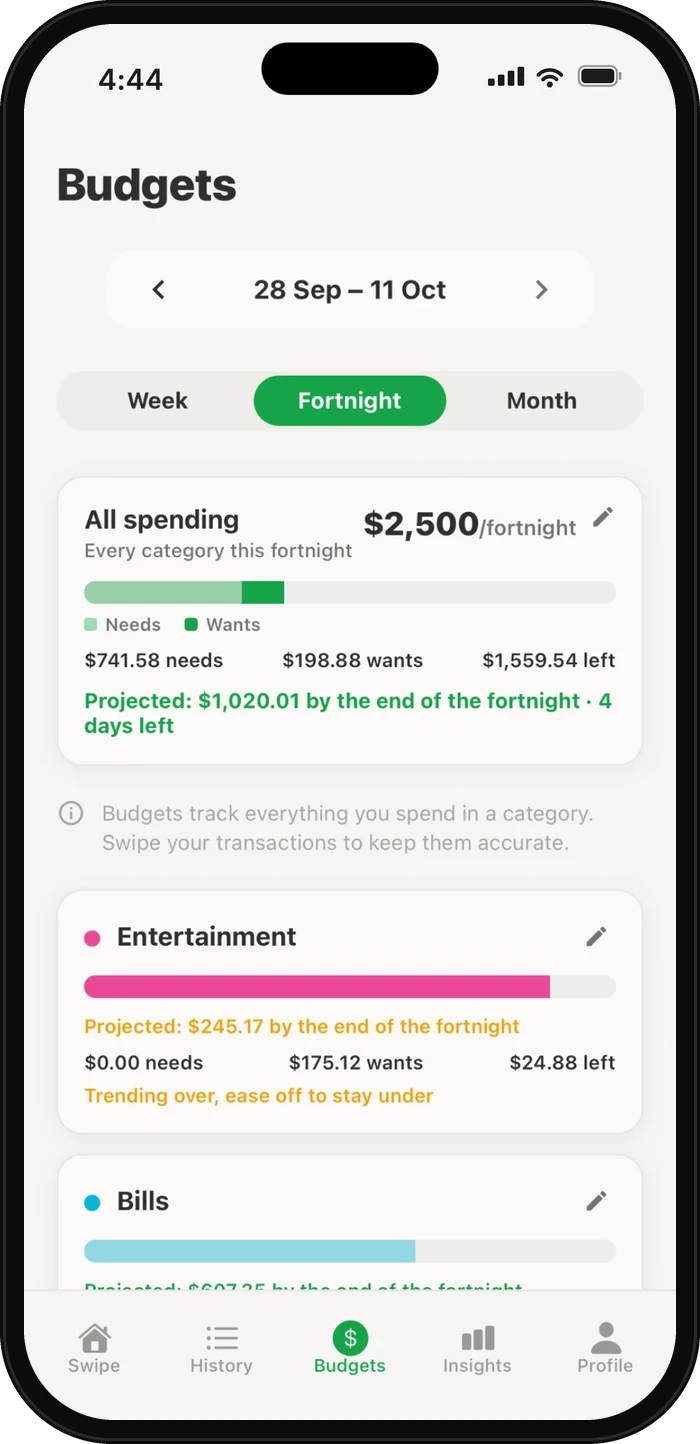
Fortnightly budgeting in five points
- Plan in fortnights, the same unit as your pay.
- Monthly bills: multiply by 12, divide by 26. Never just halve them.
- Move bill money to a separate account each payday.
- Ask providers to move due dates to just after payday.
- Two months a year have three pays. Give them a job.
Keep reading
General information only. This guide does not take your personal situation into account and is not financial advice. For free, independent help, visit Moneysmart or call the National Debt Helpline on 1800 007 007.